Lip filler migration happens when hyaluronic acid filler moves beyond the lip border into the surrounding tissue, most often showing up as a soft ridge or “shelf” above the upper lip, a blurred lip line, or a puffy look that does not match the lips you were aiming for. It can appear weeks or months after treatment, it is usually a cosmetic concern rather than an emergency, and hyaluronic acid filler can often be dissolved with an enzyme called hyaluronidase once a qualified provider has examined it.
That is the short answer, and I think it needs some unpacking, because the word “migration” gets used for several different things. Some people have filler that really did travel. Others have swelling that has not settled, a lump that is just product sitting where it was placed, or lips that have been topped up so many times the whole area looks heavy. Those situations feel the same in the mirror and are handled quite differently.
This guide is general education for adults who are either worried about how their lips look now or want to understand the risk before booking. At Rejuvenation Med Clinic in Toronto, our lip filler page describes hyaluronic acid lip fillers and says results typically last 6 to 12 months. I could not find a filler dissolving service described on that page, so I will not tell you we offer one here. If that matters to you, ask us directly when you reach out. Nothing below replaces an in-person assessment, which is the only reliable way to tell what is going on with your own lips.
Related Service: Lip Fillers at Rejuvenation Med Clinic
What lip filler migration actually means
Migration is a descriptive word more than a precise medical one. In the literature it is used for filler that is found away from where it was injected. A narrative review of facial filler migration by Wollina and Goldman defines it as the presence of filler at a location distant from the injection site. In the lips, that usually means product sitting above the vermilion border (the edge where pink lip meets skin), below the lower lip, or in the skin and muscle around the mouth.
The plain-language version
Imagine a soft gel placed inside a very mobile ring of muscle. The lips move thousands of times a day, so the gel is under gentle pressure all the time. If the amount, depth or product is not well matched to the lip, some of the gel can gradually spread out of the space it was meant to occupy. That spread is what people mean when they say their filler migrated.
What it is not
It is not the same as normal swelling in the first week, which is expected and tends to settle. It is not the same as a small firm area in the first couple of weeks while product integrates with tissue. It is also not the same as an intentionally strong lip shape. Some people simply like fuller lips, and that is a legitimate choice. The concern is when the shape is changing in a way that you did not choose and do not like.
How common is it?
As far as I can tell, nobody knows for lips specifically. The Wollina and Goldman review gathered 28 reports of migration after facial injections and describes it as relatively rare, with figures that vary a lot by area and filler type, for example up to 3% with one polyacrylamide product and 0.5% for displacement from the nasolabial folds. It also notes that the nose, lips, nasolabial folds and forehead were involved more often than the cheeks. Those numbers come from different studies, different fillers and different definitions, so they should not be read as your personal risk. I would say the takeaway is that it is not the typical outcome, but it is real enough to ask your injector about.
Why people search for it so often
Part of the reason is social media. Photos of exaggerated lips travel fast, and a lot of people look at their own lips afterwards and wonder. Another part is that hyaluronic acid has been popular for a long time, so more people are now seeing how repeated treatment looks after several years. Wanting to understand your options before you panic is reasonable.
| What you notice | What it could be | How a provider tells them apart |
|---|---|---|
| Overall puffiness in the first days | Normal swelling after injection | Timing, and whether it is settling day by day |
| Small firm areas in the first two weeks | Product integrating with tissue | Feel and follow-up, since many soften with time |
| A soft ridge above the lip border that persists or appears later | Possible migration or superficial placement | Examination in good light, touch, history of past treatments |
| Lips look heavy or overfull after many top-ups | Accumulated product, sometimes called filler fatigue | Treatment history and how much time has passed between sessions |
| Lips roll inward again, with no change above the border | A lip flip wearing off, if you had one | Treatment history, since a lip flip is a different treatment |
Signs of lip filler migration to look for
Most descriptions agree on a handful of signs, and I will list them as plainly as I can. None of them proves migration on its own. They are a reason to book a proper look.
Above the upper lip
The classic sign is a soft, slightly puffy ridge sitting on the skin above the upper lip, often called a filler mustache or shelf. The upper lip may look like it projects forward from a side view, and the natural border can look softer or less crisp than it did at the start. The cupid’s bow, the M-shaped dip in the middle of the upper lip, may look flatter or a bit bumpy.
Around the lower lip
On the lower lip, people describe a fullness that creeps below the lip line, or a lower lip that seems to hang forward. Asymmetry matters too. One side that looks more advanced than the other, especially when it is getting more noticeable rather than less, is worth mentioning.
Bumps and texture
Lumps you can feel under the skin, particularly when you smile, are another report. Lumps are one of the least specific signs, though. They can be product that was placed in lumps from the start, scar tissue, or occasionally a reaction. Health Canada lists nodules among the reported side effects of dermal fillers, along with swelling, bruising, infection and allergic reaction. That is why a lump deserves a professional opinion and not a guess from a photo.
Timing: early or late?
Some changes show up within the first weeks. Others take months or years, and the Wollina and Goldman review notes a range of presentation from 2 weeks to many years after injection, with much longer delays mostly linked to permanent fillers. For hyaluronic acid, a gradual change over several treatment cycles is a common story, because product accumulates when each top-up lands on top of the last.
| Sign | Where you might see it | Other possible explanations |
|---|---|---|
| Soft ridge or shelf | Skin above the upper lip | Natural anatomy, swelling, intentionally placed border definition |
| Blurred lip border | Edge between pink lip and skin | Swelling, sun damage, ageing of the lip line |
| Projecting upper lip in profile | Side view | Too much volume in the lip itself, which is not the same as movement |
| Visible or palpable lumps | Anywhere in or around the lip | Product clumping, early integration, reaction, scar tissue |
| Asymmetry that is getting worse | One side of the upper or lower lip | Uneven swelling, uneven placement, natural asymmetry |
Why filler might move: the main reasons
There is rarely one cause. Most explanations from clinicians and from the literature are a mix of product, amount, depth, anatomy and what happens afterwards. I will go through them roughly in the order people usually ask.
More product than the lip can comfortably hold
A lip is a small structure. If a large amount is placed in one session, or if new filler keeps being added on top of earlier filler that has not fully cleared, the tissue can reach a point where the product has to go somewhere. Wollina and Goldman list high volumes and injecting quickly under pressure among the factors linked to migration. I think this is the cause people underestimate most, because each top-up on its own looks perfectly ordinary. The accumulation is what causes trouble.
Depth, technique and product choice
Placement that is too superficial, or a product that is firmer than the tissue it sits in, can make spreading more likely. The same review points to poor technique and limited knowledge of anatomy as the most avoidable cause. I am not going to name brands or tell you which product is right, because that depends on the lip, the goal and what the provider uses, and it is a conversation for your consultation. What you can do is ask what was used and where it was placed.
Movement and pressure
The lips are constantly active. Wollina and Goldman note that massage, muscle activity, gravity and lymphatic spread may all contribute. Strong, repeated lip movement can plausibly nudge superficial product along over time. It is also why most aftercare guidance asks you not to press or massage the lips in the first day or two. Our guide to lip filler aftercare walks through what that means in practice.
Your own anatomy
Lip thickness, skin quality, muscle strength and how much natural volume you have all influence how a filler behaves. Softer, thinner tissue may hold product differently than firmer tissue. This is one reason two people with the same treatment can end up with very different results, and it is not anyone’s fault.
Aftercare and everyday habits
Heat, strenuous exercise, firm pressure and rubbing in the first days may make early shifting more likely, although there is limited direct evidence on exactly how much. It is a sensible area to be careful about without turning it into a source of guilt. If you pressed your lip on day one, that does not mean it caused anything.
| Factor | Why it may matter | What you can influence |
|---|---|---|
| Total amount of filler over time | Product accumulates when top-ups overlap | Share your full treatment history and space sessions with your provider’s advice |
| Amount per session | Large volumes may overload the tissue | Ask whether a staged plan would suit you |
| Depth and technique | Superficial or poorly placed product can spread | Choose an injector with relevant training and ask how they place lip filler |
| Product type | Different gels behave differently in mobile tissue | Ask what product is planned and why it suits lips |
| Anatomy and lip movement | Thin, soft or very mobile lips may behave differently | Little, though it should shape the plan |
| Early aftercare | Pressure and heat while product settles | Follow written instructions for the first days |
Is it migration, swelling or something else?
This is the section I would read twice if I were worried, because the most common mistake is assuming the worst too early or ignoring something that needs attention.
Swelling that has not finished settling
In the first week or two, lips can be uneven, puffy and slightly lumpy. Our lip filler page says swelling is common and typically lasts a few days to a week. Many people find their lips look different at two weeks than they did at three days. If you are inside that window, patience and your provider’s written aftercare are usually the right response, and a follow-up visit is a better judge than a mirror at 11 pm.
Lumps that are product, not movement
Some firm spots are simply filler where it was placed. They may soften as tissue integrates. A review of filler complications by Haneke notes that some products can clump in the lip with imperfect technique, and that problems are often treated with hyaluronidase or other injections. You do not need to massage a lump unless your provider has shown you how.
Too much filler in the lip itself
Sometimes the product is exactly where it was placed, and there is simply a lot of it. The lips look heavy, the border is lost under volume, and the profile looks forward. That is not migration in the strict sense, but the practical answer may be similar: a conversation about reducing or adjusting the amount.
When it is not a cosmetic question
A few signs should never be waited out. Skin that turns white, grey, dusky or mottled, sudden severe pain, spreading redness with warmth or fever, pus, trouble breathing or swallowing, or any change in vision need urgent medical attention. Haneke’s review describes blanching that extends beyond the injection area as a possible sign of a blocked blood vessel and notes that hyaluronidase is used to treat HA filler adverse effects. Call your provider immediately, and if you cannot reach them, go to an emergency department. This is separate from migration, but it is the one scenario where speed matters.
| What you notice | Often reasonable to monitor and mention at follow-up | Contact your provider promptly or seek urgent care |
|---|---|---|
| Swelling | Gradually easing over days, mild one-sided puffiness early on | Rapidly increasing, one-sided and painful, or spreading |
| Skin colour | Mild redness or bruising at injection points | White, grey, dusky or mottled patches |
| Lumps | Small, soft or softening spots in the first weeks | Hard, painful, hot or growing lumps |
| Pain | Mild tenderness that improves | Severe or worsening pain, especially with colour change |
| General symptoms | None | Fever, pus, trouble breathing or swallowing, vision changes |
| Shape change months later | Slow change in the lip border or a soft ridge | Book an assessment rather than waiting indefinitely |
How a provider assesses suspected migration
A good assessment is mostly looking, touching and asking questions. It tends to be less dramatic than people expect.
What the appointment usually covers
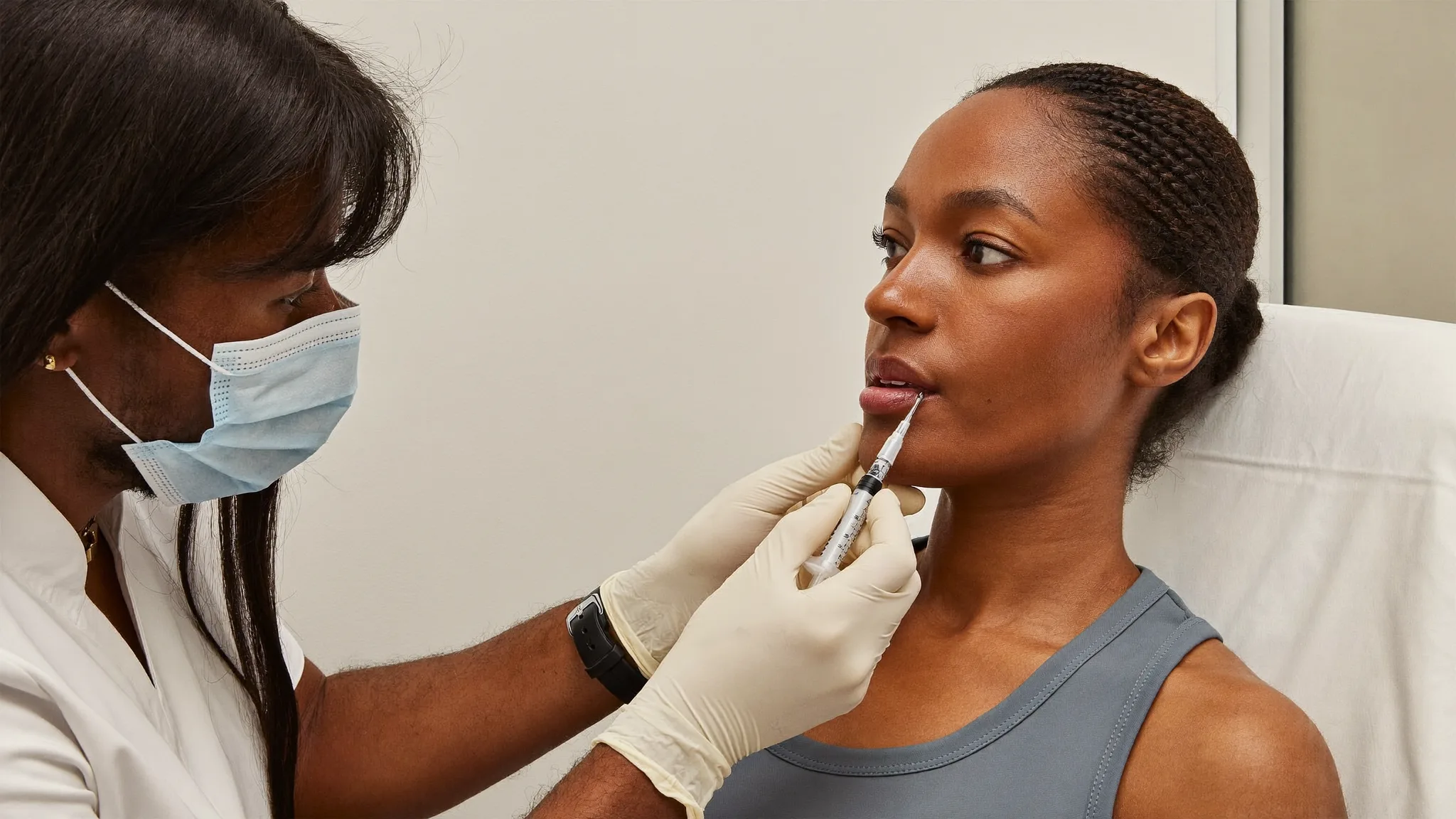
Expect questions about when you were treated, how many times, where, and what you noticed and when. A provider will usually look at the lips at rest and in motion, from the front and the side, and may feel along the lip border and the skin above it. Photographs help because the lip you see in the mirror every day changes slowly, and your memory of how it used to look may not be reliable.
When imaging comes up
Sometimes clinical examination is not enough, particularly when the type of filler is unknown. The Wollina and Goldman review describes ultrasound and MRI as ways to see filler under the skin, notes that hyaluronic acid looks different from other filler types on imaging, and says that MRI found more migration-related lesions than were suspected clinically. Imaging is not part of every cosmetic assessment, and many med spas will not offer it themselves, so a referral may be part of the plan.
What to bring so the assessment is easier
The more you can say about your treatment history, the better the advice will be. Photos taken before treatment, soon after and now are the most useful thing you can bring, ideally in daylight from the front and side.

| Bring or note down | Why it helps |
|---|---|
| Dates of every filler treatment, and where they were done | Shows how much time has passed and whether product may have accumulated |
| The product name, if you were told | Different products behave differently and may be treated differently |
| Photos from before, shortly after, and now | Shows how the shape has actually changed |
| Any lip flip or other injections around the mouth | Rules in or out other causes of a changed shape |
| Medications, supplements, allergies and cold sore history | Matters for planning any correction safely |
| What bothers you most | The plan should address your concern, not an average one |
What can be done about migrated lip filler
The right option depends on the type of filler, how noticeable the change is, and how you feel about it. I will cover the common ones, though only an assessment can tell you which applies.
Waiting
Hyaluronic acid filler is temporary. Health Canada says the effects of HA dermal fillers can last from six months to a year or more, depending on factors such as the area treated and the specific filler. If the change is mild and not bothering you, waiting is a legitimate choice. The catch is that it can take a while, and a displaced ridge will not necessarily fade on the same schedule as the filler that stayed in place.
Dissolving with hyaluronidase
Hyaluronidase is an enzyme that breaks down hyaluronic acid. The Wollina and Goldman review states that HA-induced lesions may be treated with intralesional hyaluronidase injections, and notes that early treatment tends to work faster, while late reactions may need higher or repeated doses. A provider may choose to dissolve only the problem area or a larger amount, and that decision depends on how much filler is where.
Dissolving only works for hyaluronic acid
This matters if you are not sure what you had. Other filler types do not respond to hyaluronidase. The same review says semipermanent fillers have no specific drug therapy, and that permanent fillers often need surgery. Knowing the product is part of the reason your treatment history matters so much.
Adjusting rather than removing
Sometimes the answer is not to dissolve anything. If the issue is lip volume that is simply more than you want, or if one area needs balance, a provider might suggest waiting, a smaller adjustment, or a different plan going forward. There is no single right answer.
| Option | May suit | Things to know |
|---|---|---|
| Monitor and wait | Mild change, short time since treatment, no urgency | Can take months, and the shape may not settle evenly |
| Targeted dissolving with hyaluronidase | A clear ridge or lump in a known area of HA filler | May affect nearby intended filler, and a repeat visit can be needed |
| Broader dissolving and a fresh start | Widespread accumulation or a shape you want to reset | Lips may look different for a while, and re-treatment timing varies |
| Other injections or procedures | Non-HA fillers, nodules or reactions | May involve a doctor or specialist, and sometimes surgery |
| No treatment | Someone who is comfortable with their lips as they are | Perfectly valid, and worth a follow-up if things change |
What to ask before dissolving
This is a medical treatment even when the setting is a cosmetic clinic. Ask who will do it, how much is likely to be used, how you will be monitored, and what happens if you have a reaction. The Wollina and Goldman review describes hyaluronidase allergy as rare, with prior bee or wasp venom sensitization identified as a risk factor, so tell your provider about any allergies or reactions to stings.
What the weeks after dissolving can look like
Lips may look flatter, uneven or tender for a short time, and the way they settle varies by person and by how much was dissolved. Providers differ on how long they wait before placing new filler. I have seen anywhere from two weeks to two months suggested in clinic guides, which tells me it is a judgement call. Ask your provider for their own window instead of picking one off the internet.
Lowering the chance of migration
You cannot eliminate the risk, and anyone who says they can should be asked a few more questions. You can improve the odds, though.
Before treatment
Ask how much product is planned, whether the plan can be staged, what product is intended for lips, and how the injector decides on depth. Mention any earlier filler, anywhere on the face. If you have had other treatments around the mouth, such as a lip flip, say so. Our comparison of lip flip versus lip filler may help you decide which treatment answers your actual goal.
During treatment
You do not need to supervise technique, but it is fair to ask for a conservative first session. A subtle starting point is easier to add to than to take away, which I think is the most useful single piece of advice here. Our team page has details on who works with our clients, and Health Canada advises seeing a medical professional who has experience in such procedures and who is trained to do the procedure.
After treatment
Avoid touching or massaging the lips in the first day, as our lip filler page asks, and follow whatever written instructions your provider gives. Keep your follow-up appointment, since a small adjustment is easier to judge once swelling has settled. Our aftercare guide covers the first two weeks day by day.
Over the long term
When you notice your lips gradually changing shape, book a review sooner rather than layering more product on. Spacing treatments, reviewing your history at each visit and being willing to pause are habits that reduce the chance of build-up. See our guide to how long lip fillers last for the general timeline.
| Stage | Question to ask |
|---|---|
| Consultation | How much do you plan to use today, and could a smaller first session work? |
| Consultation | What product do you recommend for lips, and why? |
| Consultation | What is your approach if I already have filler from elsewhere? |
| After treatment | Is a follow-up included, and when should it be? |
| If something looks wrong | Who do I contact, and can the filler be adjusted or dissolved here? |
| Before the next top-up | Has enough time passed, and should we review how my lips look first? |
Migration around other filler areas
Lips get the attention, but the Wollina and Goldman review also covers other areas. They report tear-trough migration at 7.7% in one systematic review, and note that injections above the deep plane near the orbital rim increase the risk of orbital migration. Cheeks were involved less often than lips, nose and forehead. If you are thinking about filler elsewhere, our posts on cheek filler, under eye filler, nasolabial fold filler and marionette lines cover each area on its own terms. The general principles above, such as conservative amounts and a provider who knows the anatomy, apply to all of them.
What this means at our clinic
We describe lip fillers on our lip filler page as hyaluronic acid based, typically lasting 6 to 12 months, with swelling usually lasting a few days to a week and bruising within a week. That page does not describe a dissolving service, and I do not want to imply one. If you are worried about filler placed here or anywhere else, use our contact page to ask what we can and cannot do. If the right step is a doctor or a different kind of specialist, we will say so.
Cost questions
We do not publish prices for correction work here, and I will not invent figures. The cost of any adjustment generally depends on how much needs to be done, whether a repeat visit is likely, and whether new filler follows. Our general lip filler cost guide and the broader dermal filler cost guide explain what drives pricing, and our financing page describes payment options. Cosmetic filler is not covered by OHIP.
Common misconceptions about migrated lip filler
“If it migrated, the injector must have done something wrong”
Sometimes technique or product choice is part of it. Often it is a combination of amount, time, anatomy and bad luck, and blame is not a useful starting point. A useful provider focuses on what can be done now.
“Dissolving ruins your natural lips”
Hyaluronidase breaks down hyaluronic acid. It is not meant to remove your own tissue, though you may experience temporary changes in the lips while they settle. Repeated or heavy dissolving is something to discuss with your provider.
“A bump means migration”
A bump can be filler that has not softened yet, an injection site reaction or something else. Do not assume the cause from a photo, and do not press or massage it unless you have been shown how.
“Migration only happens with bad filler”
Any product can potentially move. Technique, amount, depth, anatomy and time all contribute, and no filler type is immune.
“Waiting always solves it”
Sometimes it does. Other times a displaced ridge stays visibly different from the surrounding filler for much longer, and waiting becomes a quiet way of living with something that bothers you. Booking an assessment does not commit you to treatment.
When a doctor, not a med spa, is the right next step
A few situations belong with a doctor or other appropriate specialist. Hard, painful, hot or growing lumps, repeated swelling or inflammation, symptoms such as fever, or any suspected reaction deserve medical assessment. The same goes for filler of unknown type, since non-HA products need a different approach. If you have had permanent filler, speak to your doctor, because the Wollina and Goldman review notes that permanent fillers often need surgery. Anything affecting breathing, swallowing or vision is an emergency.
Deciding whether to book a consultation
You might be thinking about lip filler for the first time and want to understand migration before you decide. You might already have filler and feel something has changed. Or you might be perfectly happy and simply curious. All three are good reasons to talk to someone.
Questions to bring
How would you describe my lips right now, and what is the likely explanation? What are my options, including doing nothing? Which of those can you do here, and which would need a referral? What are the risks, what might the cost factors be, and how soon would I see a change? Is there anything in my medical history or medication list that changes the plan?
A note on expectations
Nobody can promise a particular outcome, and any plan can change once someone has actually examined you. A consultation does not commit you to anything, and if the honest answer is that no treatment is needed or that another option suits you better, we will say so.
Frequently asked questions
What is lip filler migration?
Lip filler migration is when filler moves from where it was injected into nearby tissue, often above the lip border. It can look like a soft ridge, a blurred lip line or a puffy upper lip. It may appear weeks or months later, and it needs an in-person assessment to confirm.
How do I know if my lip filler has migrated?
Common signs are a soft ridge above the upper lip, a blurred lip border, a forward-projecting upper lip or lumps you can feel. These can also be swelling or product that has not settled, so a provider should examine you. Photos taken over time help a lot.
What causes lip filler to migrate?
There is rarely a single cause. Larger amounts, repeated top-ups on top of earlier filler, superficial placement, product choice, lip movement, massage and individual anatomy have all been linked to migration. Wollina and Goldman call poor technique and limited anatomy knowledge the most avoidable factors.
How common is lip filler migration?
Nobody has a reliable figure for lips alone. A 2023 review of 28 reports describes migration after facial injections as relatively rare, with rates varying by area and product. Lips, nose, nasolabial folds and forehead were involved more often than cheeks. Your personal risk depends on your treatment.
Can lip filler migrate years later?
Yes, it is possible. A review of facial filler migration reports presentation anywhere from 2 weeks to many years after injection, though very late cases were mostly linked to permanent fillers. With hyaluronic acid, gradual change over repeated top-ups is a more usual story.
Will migrated lip filler go away on its own?
Hyaluronic acid filler is temporary, and Health Canada says its effects can last from six months to a year or more. A mild change may fade as the product breaks down, but it can take months. If it bothers you, ask your provider about options.
Can migrated lip filler be dissolved?
If the filler is hyaluronic acid, it can often be dissolved with hyaluronidase injections, according to a narrative review of filler migration. Other filler types do not respond to it and may need different treatment. Knowing what you were injected with is the first step.
Is dissolving lip filler safe?
It is a medical treatment with risks. Hyaluronidase allergy is described as rare, with prior bee or wasp venom sensitization noted as a risk factor, and lips can look flat or uneven for a while. Ask who will do it, how you will be monitored and what happens if you react.
How long should I wait to get lip filler again after dissolving?
Providers give different answers, and clinic guides suggest anything from a couple of weeks to a couple of months. The right window depends on how much was dissolved and how your lips settle. Ask your provider for their own recommendation after examining you.
Is lip filler migration dangerous?
Migration is usually a cosmetic concern rather than an emergency. That said, white, grey or dusky skin, severe pain, spreading redness with fever, trouble breathing or swallowing, or vision changes need urgent medical care. Those signs are a different problem from migration and should never be waited out.
Is it migration or just swelling?
Swelling is expected in the first days and usually eases over the first week or two. Migration tends to appear or persist later, often as a ridge above the lip border. If you are within two weeks of treatment, check with your provider at follow-up before assuming the worst.
Can massage fix migrated lip filler?
Not safely on your own. Massage and pressure are among the factors linked to filler movement, and Health Canada lists nodules and improper placement among possible adverse reactions. Only massage a lip if your provider has shown you how. Persistent lumps should be assessed in person.
Does lip filler migration happen with every filler?
No filler is described as immune. Migration has been reported with several filler types, and permanent fillers carry a higher risk of very late problems. Hyaluronic acid is generally temporary and can often be dissolved, which is one reason it is widely used in lips.
Can too many top-ups cause migration?
It is a commonly cited concern. Adding new filler before earlier product has cleared can lead to accumulation, and high volumes are listed among factors linked to migration. Share your full history with your injector and ask whether a review or a longer gap makes sense before your next session.
Is a lip flip the same as lip filler migration?
No. A lip flip uses a neuromodulator to relax part of the upper lip muscle so the lip rolls out slightly, and it is a different treatment from filler. If your lip rolls inward again, the effect may simply be wearing off. Mention any lip flip history at your assessment.
Can I prevent lip filler migration completely?
No, and nobody can promise that. You can lower the odds by choosing an experienced provider, asking about the amount, product and depth, staging larger changes, following aftercare, keeping follow-ups and sharing your full treatment history before each top-up.
What should I bring to an appointment about migrated filler?
Bring dates of every filler treatment, the product name if you know it, and photos from before, soon after and now in daylight. Mention medications, allergies and cold sore history. A short note about what bothers you most helps the plan focus on your concern.
Can I get a second opinion if my filler migrated?
Yes. Many people find it useful, particularly if they are unsure about the first provider’s advice. Bring your history and photos, ask what the likely explanation is and what options exist, and take your time. A consultation does not commit you to treatment.
Does Rejuvenation Med Clinic offer filler dissolving?
Our lip filler page describes hyaluronic acid lip fillers but does not describe a dissolving service, so we do not want to assume one. Please use our contact page to ask what we can and cannot do for your situation, and we will tell you plainly if another provider is a better fit.
Should I see a doctor about migrated lip filler?
See a doctor for hard, painful, hot or growing lumps, repeated swelling, fever, filler of unknown type or permanent filler. Seek emergency care for breathing, swallowing or vision problems. For a mild cosmetic change, an assessment by a trained injector is a reasonable first step.
Lip filler migration is one part of the broader cosmetic injectable services and dermal fillers we talk through with clients in Toronto, and our injectable treatment FAQ answers more general questions. If you would like a plain conversation about your lips, your history and your options, you can request a consultation. This article is general education and not medical advice or a diagnosis. A consultation does not commit you to anything, your plan can change after an individual assessment, and if no treatment or a different option suits you better, we will say so directly.