
Chin Botox in Toronto: What It Can Smooth, What It Cannot, and What to Ask First

Chin Botox is a small injection of botulinum toxin type A into the chin muscle, called the mentalis, to relax it for a few months. People usually ask for it when the chin looks dimpled like an orange peel, when a crease sits just above the chin, or when the chin pulls upward and bunches whenever they talk or smile. It softens muscle-driven texture. It does not rebuild a small chin, remove fat or tighten loose skin.
That is the quick answer, and I think it is worth slowing down a little, because “chin Botox” gets used for several different goals that do not all respond the same way. A pebbled chin that moves when you purse your lips is one situation. A chin that looks short from the side is another, and Botox on its own will not change it. And a soft fullness under the chin is a third, which is a fat and skin question more than a muscle one.
This guide is general education for adults in Toronto who are thinking about it. At Rejuvenation Med Clinic, our chin dimples Botox page describes the treatment, and our wider Botox services in Toronto page lists the other areas we treat. Nothing below is a diagnosis or a promise of how your chin will respond. Your anatomy, your smile and your goals decide the plan, and not treating a chin you are comfortable with is a perfectly good choice.
Related Service: Chin Dimples Botox at Rejuvenation Med Clinic
What chin Botox actually is
Botox is a brand name for onabotulinumtoxinA, one of several botulinum toxin type A products used in cosmetic medicine. When a very small amount is placed in a muscle, it blocks the nerve signal that tells that muscle to contract, so the muscle moves less for a while. The skin sitting over a muscle that moves less tends to look smoother, because it is no longer being bunched up thousands of times a day.
The mentalis, the muscle most people mean
The mentalis is a small, paired muscle at the very tip of the chin. It lifts the chin and pushes the lower lip forward, which is why some injectors call it the pouting muscle, a term used in Harley Academy’s clinical article on chin Botox. When it is very active, the skin over it can look dimpled, and the crease above the chin can look deeper when you speak.
Neighbouring muscles and why they matter
Right beside the mentalis sits the depressor labii inferioris, a muscle that helps pull the lower lip down when you smile. If toxin spreads into it, a smile can look slightly uneven for a while. This is the main reason chin injections are described as small volume, high precision work, and the reason it matters who you choose and how carefully they map your face before treating. Some providers also address the depressor anguli oris for a downturned mouth, which is a separate plan that needs its own assessment, and our marionette lines Botox guide covers that neighbouring area.
What “chin Botox” does not refer to
People sometimes use the phrase for under-chin fullness or for slimming the jaw. Those are different treatments. Jaw slimming targets the masseter, a much larger muscle at the angle of the jaw, which we explain in our masseter Botox guide. Under-chin fullness is discussed further down.
What chin Botox can help with
Botox treats muscle activity, so it helps most when muscle activity is part of what you see. The concerns below are the ones providers most often describe for this area.
A dimpled or pebbled chin
Sometimes called an orange peel, cobblestone or peach pit chin, this is skin that puckers when the mentalis tightens. Harley Academy describes a simple check, where you purse your lower lip and the provider watches whether the chin dimples. If it does, relaxing the muscle may soften the texture. If the skin looks pebbled even when your face is at rest, the cause may be skin quality or thin tissue over the chin, and muscle relaxation will help less.
A deep crease above the chin
The labiomental crease is the horizontal groove between the lower lip and the chin. Genetics, volume change and ageing all shape it, so Botox may soften how much it folds during movement without erasing a crease that is there at rest. For a crease that stays deep when you are relaxed, providers often discuss filler or skin treatments instead of, or alongside, toxin.
A chin that rides upward when you talk
Some people notice the chin pushing up toward the lip, creating a tense, bunched look, particularly when concentrating or smiling. Relaxing the mentalis can reduce that pull. It is a subtle change, and a good provider will tell you so before you book.
What it will not do
It will not add projection to a recessed chin, tighten loose skin, dissolve fat or change the shape of the jawbone. For those goals the options are different, and the next sections compare them.
| What you notice | Is muscle activity likely involved? | Options a provider may discuss |
|---|---|---|
| Dimpled skin when you purse your lips | Often yes | Botox to relax the mentalis, sometimes with skin treatments |
| Pebbled skin even at rest | Possibly less so | Skin quality treatments, a closer look at tissue thickness |
| Crease above the chin that deepens when you talk | Partly | Botox for movement, filler for a fixed crease |
| Chin that looks short or recessed in profile | No | Filler or surgical consultation for structure |
| Fullness under the chin | Rarely the chin muscle | Fat reduction, skin tightening or a different assessment |
| Chin that bunches upward with expression | Often yes | Botox after a full lower face assessment |
Is chin Botox approved by Health Canada?
This is a fair question and one that many websites skip. The Health Canada product monograph for Botox Cosmetic (AbbVie, revision dated November 2022, which is the version I read) lists its cosmetic use as the treatment of upper facial rhytides, including forehead, lateral canthus and glabellar lines. The chin and the mentalis muscle are not mentioned in it. You can read the document yourself in the Health Canada product monograph for Botox Cosmetic, and a newer revision may exist, so it is worth checking the Drug Product Database for the current one.
What off-label means in practice
Off-label simply means using an authorized product in a way that is not written in its monograph. It is common across medicine, and many cosmetic treatments are done this way. It also means the evidence for the chin is smaller and comes more from clinical experience and training than from large trials. Healthline’s overview says the same thing, noting that chin use is off-label and that more clinical research would help.
What to ask your provider
You can ask, plainly, whether they treat the chin regularly, which muscles they plan to target, and what they will do if you are not happy at the two week review. A clear, unhurried answer is a good sign. Candidacy, dosing and technique are decisions for the qualified professional who examines you, and nothing here replaces that.
Chin Botox compared with other options
Because “chin concerns” is such a wide group, it helps to see Botox beside the alternatives. The right choice often depends on whether your main issue is movement, volume, skin or fat.
Botox and dermal filler
Filler adds structure and projection, which toxin cannot do. Botox relaxes movement, which filler cannot do. Some people end up with both, in a sequence that depends on the assessment. Our dermal filler page describes the fillers we offer. It lists the lips, cheeks and areas around the mouth and eyes, and does not list the chin, so if chin filler is your goal, ask directly at your consultation whether and how it can be done before you book.
Botox and treatments for the skin itself
If texture is the main complaint, treatments that act on the skin surface or collagen, such as microneedling, may be worth discussing, either alone or after muscle relaxation. They work differently and on a different timeline.
Botox and fat or skin laxity under the chin
Under-chin fullness is a separate topic, and we look at it in the double chin section below.
| Approach | What it acts on | Typical role for the chin | Main limitation |
|---|---|---|---|
| Botulinum toxin (Botox) | Muscle movement | Softens dimpling and bunching | Temporary, and does not add volume |
| Dermal filler | Volume and structure | Adds projection or fills a fixed crease | Does not relax muscle movement |
| Microneedling or resurfacing | Skin texture and collagen | Improves surface quality | Needs a series and recovery time |
| Fat reduction treatments | Fat beneath the chin | Addresses fullness, not dimpling | Not suited to every anatomy |
| Surgical consultation | Bone and structure | For significant recession or asymmetry | Different recovery and risk profile |
Can Botox help a double chin?
Not directly, and I would rather say that early. A double chin usually comes from fat beneath the chin, loose skin, the position of the jaw and neck, or a mix of all of those, and most of that is not muscle activity in the chin. Some providers use toxin around the neck or jawline for specific reasons, and some people notice that relaxing the mentalis changes how the chin sits, but that is a subtle effect and not a fat-reduction treatment.
What may be more relevant
If fullness is your concern, our guide to fat reduction options for a double chin in Toronto compares the approaches, and our Belkyra and Kybella page describes an injectable option for under-chin fat. If the main issue is lower face skin laxity, our jowls treatment guide and skin tightening page are better places to start.
Vertical neck bands
Bands running down the front of the neck are a separate muscle concern, the platysma. We cover it in our platysmal bands Botox guide.
Who may be a good candidate, and who should wait
Whether Botox suits you is a clinical decision made after an assessment, and this section is only a general picture.
People who often have a reasonable fit
Adults with visible chin dimpling or bunching that clearly moves with expression, who understand that the effect is temporary and who are comfortable with a small amount of trial and adjustment at a review visit.
People who may be better served by something else
Those whose main concern is a recessed chin, significant volume loss or fullness under the chin may find toxin on its own disappointing. A provider who tells you that at the start is doing you a favour.
People who should not be treated, or should wait
The Health Canada monograph for Botox Cosmetic lists hypersensitivity to botulinum toxin type A or to the formulation, and infection at the proposed injection site, as contraindications. It advises extreme caution with neuromuscular junction disorders such as myasthenia gravis and Lambert-Eaton syndrome, and with peripheral motor neuropathic diseases. It says the product should not be used during pregnancy, and that caution is advised while breastfeeding because it is not known whether it passes into milk. Our Botox page also asks pregnant or breastfeeding clients to wait until it is appropriate. Tell your provider about every medical condition and medicine you take.
| Situation | General consideration | Who decides |
|---|---|---|
| Visible dimpling that moves when you purse the lips | Often a reasonable topic to explore | Your injector after assessment |
| Recessed or short chin | Toxin alone is unlikely to change structure | Your injector, possibly a surgeon |
| Pregnancy or breastfeeding | Monograph advises against use in pregnancy and caution while breastfeeding | Your injector and your doctor |
| Neuromuscular condition | Monograph advises extreme caution | Your doctor first |
| Skin infection at the site | Listed as a contraindication | Treatment waits until it clears |
| Allergy to a toxin product | Listed as a contraindication | Your injector and your doctor |
What a consultation usually involves
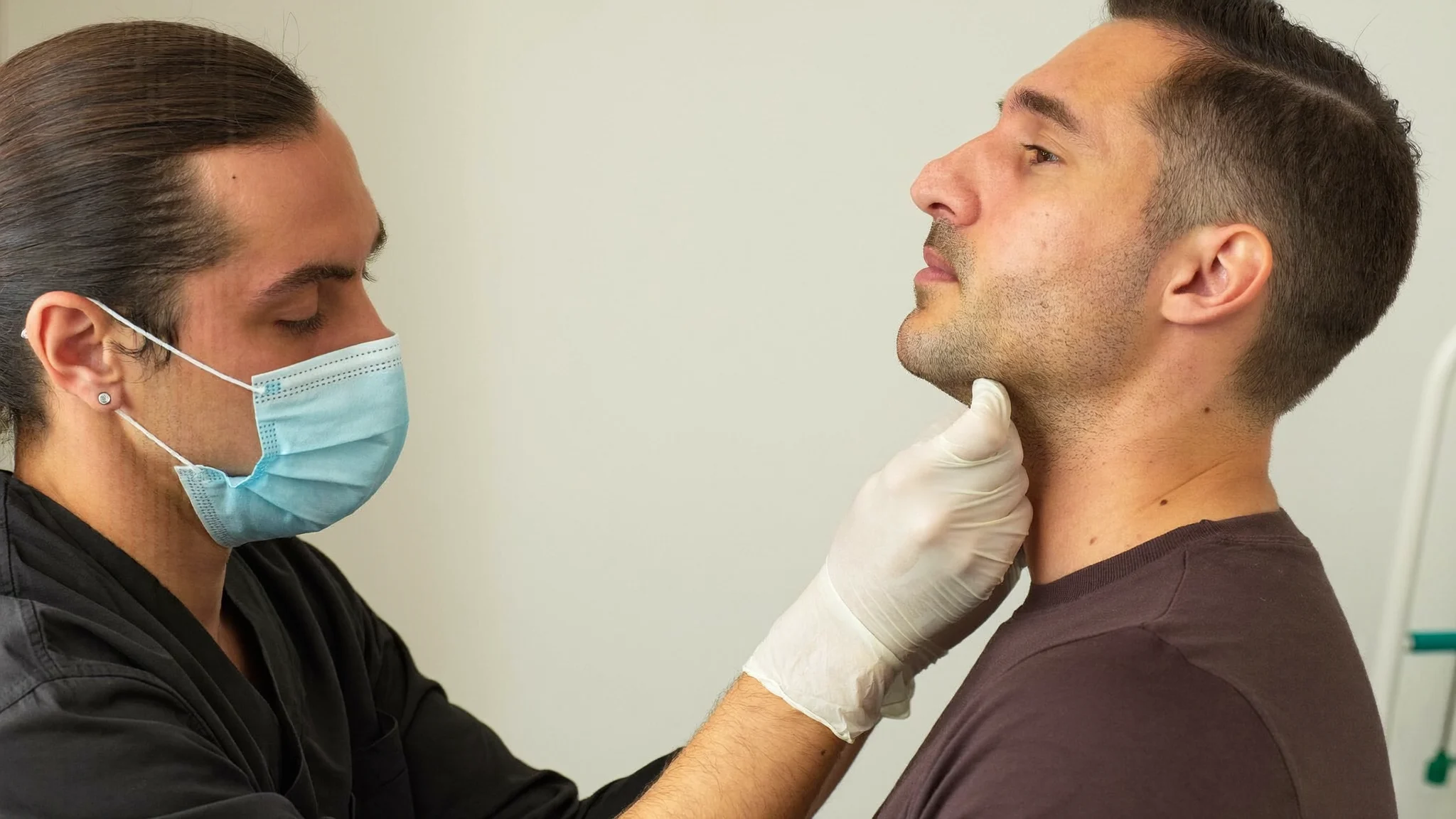
A good chin consultation is mostly looking and talking. Expect questions about what bothers you, when you first noticed it, your medical history, your medicines, any past toxin or filler and whether you are pregnant or breastfeeding or planning to be.
How the chin is assessed
The provider will probably watch your face at rest, while you speak and while you smile, from the front and from the side. They may ask you to purse your lower lip so they can see whether the chin dimples and where the pull comes from. Good lighting and a patient pace matter more than any fancy equipment.
What a clear plan includes
You should hear which muscles will be treated, what you can realistically expect, how long it lasts, what the risks are and when you will be seen again to review. It is also reasonable to hear that your goal would be better served by a different treatment, or that waiting is fine. At Rejuvenation Med Clinic you can read about our team, and our Botox page says Botox should be given by a skilled professional under a physician’s supervision.
The treatment itself
The injections for the chin are small and quick. Our chin dimples page says the procedure typically takes 15 to 20 minutes, and that most people feel brief discomfort, with topical numbing available if needed. I would add that “most” is not “all”, and if you are sensitive to needles, say so at the start.
Dosing and technique
Exactly where and how much is a clinical judgment based on your muscle, your smile and your face. Sources that discuss technique describe very small amounts placed carefully, and I am deliberately not listing numbers here, because a number copied from a website is not a plan for your chin.
Before you go
Our chin page suggests avoiding blood-thinning medicines and alcohol for 24 to 48 hours beforehand to lower the chance of bruising. Please do not stop any prescribed medicine on your own, though. Ask your provider or doctor first.
How long chin Botox takes to work and how long it lasts
Botox is not instant. The effect builds over days and fades over months, and the numbers differ a little between sources, which I think is useful to see side by side.
| Stage | What sources describe | Source |
|---|---|---|
| First change | Early improvement within about 3 to 7 days | Our chin dimples page |
| Full effect | Around two weeks | Our chin dimples page |
| Typical duration | 3 to 4 months | Our chin dimples page and Botox page |
| Duration in the monograph | About 3 months, with line reduction for up to 120 days | Health Canada monograph for Botox Cosmetic |
| A wider range | Roughly 3 to 6 months on average | Healthline |
| A shorter estimate | About 12 weeks, varying between people | Harley Academy |
Metabolism, dose, how strongly you use the muscle and the treated area all play a part, so your own timeline may land anywhere in those ranges. The effect is temporary, and the muscle goes back to moving as before once the toxin wears off.
Aftercare, step by step
Aftercare for the chin is simple. Our chin page advises avoiding touching or massaging the treated area and avoiding strenuous facial movement for at least 24 hours.
The first day
Keep your hands off your chin, skip hard workouts if your provider advises it and avoid pressure such as leaning your chin on your hand. A clean cool compress, without pressing, may help if the spot is tender. Ask your provider what they suggest for you.
The first two weeks
Watch for how the chin moves as the effect arrives, and note anything that feels odd. If your smile feels uneven or your lower lip feels heavy, tell your provider. That conversation is much easier than waiting to see what happens.
The review visit
A review at about two weeks lets your provider check the result while it is fully visible and decide whether anything needs adjusting. Harley Academy notes that an under-treated deep muscle can leave some movement that is addressed at review, so ask when yours is booked.
| When | Usually sensible | Worth raising with your provider |
|---|---|---|
| First 24 hours | Do not rub or massage, avoid strenuous facial movement | Unusual swelling or severe pain |
| Days 1 to 7 | Gentle skincare, sun protection, normal routine | A smile that looks uneven |
| Week 2 | Attend your review visit | Remaining dimpling or movement |
| Weeks 3 to 12 | Note when the movement returns | Any change in speaking or eating |
Risks, side effects and warning signs
Chin Botox is a small procedure and serious problems are uncommon, but it is still an injection of a drug with a boxed warning on its monograph, so it deserves a straight description.
Common and usually temporary effects
Our chin page lists redness, mild swelling, mild discomfort or bruising at the injection site, usually settling within hours to days. Headache is reported too in general Botox information, including on Healthline.
Effects specific to the chin
If toxin affects the neighbouring depressor labii inferioris, you could see an uneven smile and a heavy lower lip. Harley Academy says these effects tend to settle over 6 to 12 weeks, and that careful assessment and anatomical knowledge help lower the chance. You may also notice that the chin looks flatter than expected when it is relaxed, which is part of why a conservative first treatment is often preferred.
Rare serious effects
The monograph’s boxed warning describes distant spread of toxin effect, with symptoms reported from hours to weeks after injection, including swallowing and breathing difficulties that can be life-threatening. It is rare, but it is the reason to treat new difficulty swallowing, speaking or breathing as an emergency and not something to wait out.
| What you notice | Typical meaning | What to do |
|---|---|---|
| Small red dots, mild swelling, tenderness | Common injection effects | Usually settle on their own, mention at review |
| A small bruise | Common and temporary | Gentle care, ask your provider if it worries you |
| Uneven smile or heavy lower lip | Possible effect on a neighbouring muscle | Contact your provider, effects usually fade over weeks |
| Chin looks flat or stiff | A strong effect on the muscle | Contact your provider for review |
| Difficulty swallowing, speaking or breathing | A possible sign of a serious reaction | Seek emergency care immediately |
| Spreading redness, heat, pus or fever | Possible infection | Seek medical care promptly |
Why does my chin look weird after Botox?
It is one of the questions people ask most, and I think it deserves its own answer. The chin can look flatter, a little stiff or slightly odd for a few weeks, especially in the first two or three weeks while the muscle settles. That does not always mean something went wrong.
When it is a normal adjustment
If the chin looks smoother and moves less, that may simply be the result you asked for, and the unfamiliar look often feels normal within days.
When to call
If your smile looks uneven, your lower lip feels heavy or you have trouble with speech or eating, contact your provider promptly. The effect is temporary, and a provider who knows the area can explain what is happening and what to expect.
Chin Botox for different faces and different people
Chin anatomy varies. Some chins have a strong cleft, some have thin skin, some have a mentalis that barely moves. None of that is a flaw, and none of it is a reason to treat. The question is only whether something about your chin bothers you enough to want to explore a change.
Skin tone, age and gender
Botox acts on the muscle and not on the skin surface, so skin tone is less central here than it is for light or laser treatments, though your provider will still review your whole history, and any skin treatments you combine with it need separate thought. Adults of any age, gender and background can have chin dimpling for ordinary reasons, and no one needs to apologise for wanting to talk about it, or for deciding against it.
Natural expression
A common worry is losing the way the chin moves when you laugh or speak. Our chin page says that when it is done by a specialist, Botox relaxes the muscle without compromising natural expressions. I would still phrase it as a goal the provider aims for, and discuss it openly at the consultation.
Combining chin Botox with other treatments
The chin rarely sits alone. It connects to the lips, the corners of the mouth, the jawline and the neck, so people often wonder about treating more than one thing.
Neighbouring areas
Our guides to marionette lines, the lip flip and gummy smile correction describe areas that sit close to the chin. Treating several areas at once is a decision for the provider, not a default.
Lower face structure
For volume and jawline shape, you may want to read about cheek filler, non-surgical jawline sculpting and how Botox compares with Dysport. Our cosmetic injections page gives an overview of what the clinic offers.
What affects the cost of chin Botox
Price depends on how many units are needed, the provider’s experience and the clinic, and no honest website can quote your total without seeing you. Our chin dimples page gives a range of $300 to $600 per session in Toronto, and our Botox page says Botox typically costs between $10 and $20 per unit. Both can change, so please confirm current pricing when you book.
| Factor | Why it matters |
|---|---|
| Amount of product | Strongly active muscles may need more than lightly active ones |
| Number of areas treated | Chin alone costs less than chin plus neighbouring areas |
| Provider experience | The chin has less margin for error than larger muscles |
| Follow-up visits | A review or touch-up may be priced separately, so ask |
| How often you repeat it | The effect is temporary, so cost recurs over time |
If you want to spread out the cost, our financing page describes the options we offer, and our Botox cost guide goes deeper into pricing factors. Our dermal filler cost guide is there if you are weighing filler alongside.
Questions to ask at a chin Botox consultation
Writing questions down helps. These are the ones I would take with me.
| Topic | Question |
|---|---|
| Experience | How often do you treat the chin, and who will treat me? |
| Assessment | Which muscles do you think are involved in my chin? |
| Expectations | What will change, and what will not? |
| Approval | How do you explain that chin treatment is off-label? |
| Risks | What could happen to my smile, and what happens if it does? |
| Follow up | When is my review, and what happens if I need an adjustment? |
| Alternatives | Is filler, a skin treatment or no treatment a better fit for me? |
| Costs | What is the total, including any review visit? |
Common misconceptions about chin Botox
It will make a small chin bigger
No. Structure comes from bone and volume, not from muscle relaxation, and for that the conversation is about filler or surgery.
It melts a double chin
Also no. Botox does not dissolve fat. Under-chin fullness needs a different approach.
It is permanent after a few sessions
It is not. The effect wears off, and the muscle returns to its usual activity.
It is risk-free because it is small
Small injections reduce the amount of toxin, but they do not erase risk, and the proximity of the lip muscles is exactly why the chin takes skill.
Deciding whether to book a consultation
If your chin dimples or bunches in a way that bothers you, a consultation is a reasonable way to learn what is possible. If it does not bother you, there is nothing to fix. At Rejuvenation Med Clinic you can book a consultation or contact us with questions, and our injectable treatment FAQ covers common questions. Please bring your medical history, a list of medicines and any past injectable treatments, and ask about candidacy, risks, alternatives and current pricing. A consultation does not commit you to treatment, and your plan can change after an individual assessment. If a different option suits you better, or no treatment at all, we would rather say so directly.
This article is general education and not medical advice, a diagnosis or a guarantee of results. See a qualified healthcare professional for guidance about your own situation.
Frequently asked questions
What is chin Botox?
Chin Botox is a small injection of botulinum toxin type A into the mentalis, the muscle at the tip of the chin. It relaxes the muscle for a few months so dimpling, bunching or a deep crease above the chin may look softer. It does not add volume, remove fat or tighten loose skin.
Is chin Botox safe?
Serious problems are uncommon when it is done by a trained provider, but it is still a drug injection. Common effects are redness, swelling or bruising. A rare risk is spread of toxin effect, which can cause swallowing or breathing trouble and needs emergency care. Your provider should review your history first.
Is chin Botox approved by Health Canada?
The Health Canada monograph for Botox Cosmetic that I read lists upper facial lines, namely forehead, lateral canthus and glabellar lines. It does not mention the chin, so chin treatment is an off-label professional use. Ask your provider how they approach it and what their experience is.
How long does chin Botox last?
Sources differ a little. Our chin dimples page says 3 to 4 months, the Health Canada monograph describes about 3 months, and Healthline gives roughly 3 to 6 months. Your own result depends on dose, metabolism and how active the muscle is, and it is temporary.
How long does chin Botox take to work?
Our chin dimples page says early improvement appears within about 3 to 7 days, with the full effect around two weeks. That is why a review visit at about two weeks is useful, because the result is fully visible by then and any adjustment can be discussed.
Does chin Botox hurt?
Most people feel brief discomfort from the fine needles. Our chin dimples page says topical numbing is available if needed. Sensitivity differs between people, so if you dislike needles or have felt faint before, tell your provider at the start and they can adjust how they work.
Can Botox fix a dimpled or orange peel chin?
It may soften dimpling that comes from an active mentalis, which is often seen when you purse your lips. If the skin looks pebbled even at rest, the cause may be skin or tissue thickness, and Botox will help less. An in-person assessment is the only reliable way to tell.
Will Botox tighten my chin?
No. Botox relaxes muscle and does not tighten loose skin. Skin laxity needs different approaches, such as radiofrequency or other tightening treatments, and results vary. If tightness is your main concern, ask your provider to look at the whole lower face before deciding what to treat.
Can Botox get rid of a double chin?
Not directly. A double chin usually involves fat beneath the chin, loose skin or neck and jaw position, and Botox does not dissolve fat. Other options exist for under-chin fullness, such as injectable fat reduction or skin tightening, and a consultation can help work out which fits.
Will my chin go back to normal after Botox?
Yes, the effect is temporary. As the toxin wears off over a few months, the mentalis returns to its usual activity and dimpling or bunching may come back. Many people repeat treatment to maintain the look, and others choose to stop and let the muscle go back to normal.
Why does my chin look weird after Botox?
The chin can look flatter or stiffer for a few weeks while the muscle relaxes, which is often a normal adjustment. If your smile looks uneven or your lower lip feels heavy, a nearby muscle may be involved. Contact your provider, because the effect is usually temporary and they can explain what to expect.
Can chin Botox change my smile?
It can if toxin reaches the depressor labii inferioris beside the mentalis, which may cause an uneven smile or heavy lower lip. Harley Academy says these effects tend to settle over 6 to 12 weeks. Careful assessment and precise placement are intended to lower that chance, so ask how your provider avoids it.
What are the riskiest areas for Botox?
Areas where small muscles sit close to ones that control speech, eating or smiling need the most care, including around the mouth, the lower face and the neck. The chin is small and close to the lip muscles. Risk depends more on the provider’s skill and your anatomy than on the area alone.
Can I get chin Botox while pregnant or breastfeeding?
The Health Canada monograph says Botox Cosmetic should not be used during pregnancy and advises caution while breastfeeding, since it is not known whether it passes into milk. Our Botox page also asks pregnant or breastfeeding clients to wait. Talk to your doctor and your provider about timing.
How much does chin Botox cost in Toronto?
Our chin dimples page gives a range of $300 to $600 per session, and our Botox page says Botox typically costs between $10 and $20 per unit. Your total depends on units, provider experience and the number of areas treated, and prices can change, so confirm the current cost when you book.
Is chin Botox better than filler?
They do different jobs. Botox relaxes movement, so it suits dimpling and bunching. Filler adds volume and structure, so it suits a recessed chin or a crease that stays deep at rest. Some people use both. Our dermal filler page does not list the chin, so ask whether chin filler is offered.
Can men have chin Botox?
Yes. Chin dimpling and bunching happen in people of every gender, and the same assessment, cautions and aftercare apply. The plan depends on your muscle, skin and goals, and not on who you are. A provider should adjust the approach to your anatomy and not to a stereotype.
What should I avoid after chin Botox?
Our chin dimples page advises avoiding touching or massaging the treated area and avoiding strenuous facial movement for at least 24 hours. It also suggests skipping blood thinners and alcohol for 24 to 48 hours beforehand. Follow your own provider’s instructions, and never stop a prescribed medicine without asking your doctor.
When should I see a doctor after chin Botox?
Seek emergency care right away for difficulty swallowing, speaking or breathing, which can signal a serious reaction. Get prompt medical care for spreading redness, heat, pus or fever. Contact your provider if your smile looks uneven or your lower lip feels heavy, or if anything feels wrong.